
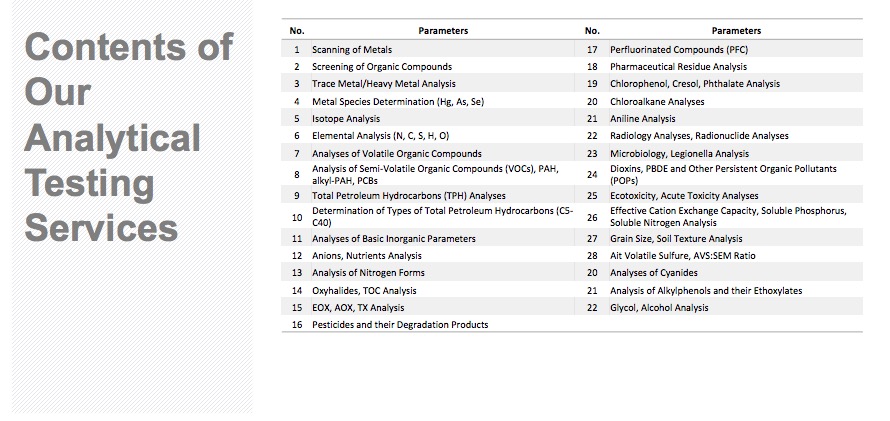
Soil, Landfill, and Solid Waste Analysis services ensure environmental compliance and safety. Advanced techniques identify contaminants and assess the quality and stability of soil and waste materials. This enables industries to manage their environmental impact, optimize waste management processes, and comply with relevant regulations.
Soil Index Testing
•Moisture content by oven-drying method
•Liquid limit by Casagrande apparatus method
•Liquid limit by the cone penetrometer method
•Plastic limit and plasticity index
•Shrinkage characteristics by linear shrinkage
•Density by linear measurement method
•Particle Density by Gas Jar Method and Small Pycnometer Method
•Particle size distribution by sieving (wet and dry) and hydrometer method
Soil Gas Testing Services
Soil gas testing services involve passive and active sampling methods to assess subsurface gas contamination. Passive sampling uses sorbent media left in the soil for a set period, analyzed via thermal desorption (TD) or gas chromatography-mass spectrometry (GC-MS). Tools like the Waterloo Membrane Sampler and Radiell Soil gas testing services, and Passive Samplers are commonly used to detect VOCs, hydrocarbons, and various gases. Active sampling involves extracting samples through TO-15 canisters (negative pressure, GC-MS analysis, 62 compounds) or TO-17 sorbent tubes (thermal desorption, GC-MS analysis, 56 compounds). Active methods are preferred for vapor intrusion assessments and health risk evaluations.
Soil Analysis
Soil analysis is conducted under the Regulation on Control of Soil Pollution and Point Source Contaminated Sites and the Regulation on the Use of Domestic and Urban Sewage Sludge in Soil within the framework of environmental legislation.
For contaminated site assessment and remediation, consultancy firms authorized by the Ministry of Environment and Urbanization perform pollution detection studies. Soil samples collected during field activities, such as on-site measurements, drilling, sampling, and homogenization, are analyzed in accredited environmental laboratories to determine the extent of soil contamination and generate comprehensive reports.
Additionally, when sewage sludge is intended for soil application, soil samples from the targeted area are analyzed to ensure compliance with environmental standards, supporting the issuance of a soil analysis certificate.
Soil Strength Test Methods
•Unconfined compressive strength
•Shear strength by the laboratory vane method
•Undrained shear strength in triaxial compression (without pore pressure measurement)
•Undrained shear strength in triaxial compression with multistage loading (without pore pressure measurement)
•Consolidated-undrained triaxial compression with pore pressure measurement
•Consolidated-drained triaxial compression with measurement of volume change
•Unconsolidated-undrained triaxial compression test with pore pressure measurement
•Determination of shear strength by direct shear
Soil Permeability and Compressibility Tests
Element provides permeability tests of soil using the falling-head test method and can carry out a One-Dimensional Consolidation test to identify the consolidation characteristics of soils of low permeability.
•Constant-head permeability test – Used for sandy soils
• Falling-head permeability test – Suitable for fine-grained soils
• Hydraulic conductivity measurement – Determines water movement through soil layers
Soil Organics Testing and Analysis
•Alcohols
•Amines
•Glycols
•Herbicides
•Hydrocarbons
•Pesticides
•Petroleum
•Volatile Organic Compounds
•And other emerging contaminants
Sediment Analysis
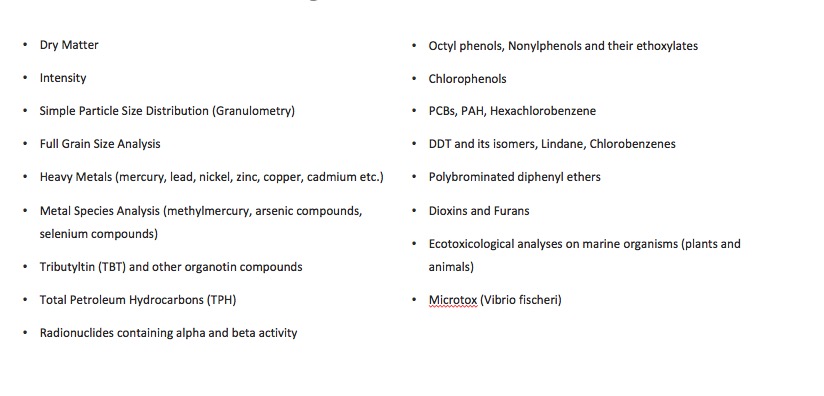
Sediment analysis is conducted under the Regulation on the Control of Pollution Caused by Hazardous Substances in Water and Environment and the Regulation on Environmental Management of Dredging Material. Sediment consists of organic and inorganic materials accumulated at the bottom of water bodies.
Sediment analysis is required before initiating dredging activities to assess potential environmental risks. Additionally, the analysis of hazardous substances in sediments must be reported annually to ensure compliance with environmental regulations and support effective pollution control measures.
Sewage Sludge Analysis
Sewage sludge analysis is regulated under the Regulation on the Use of Domestic and Urban Sewage Sludge in Soil and the Regulation on Landfilling of Waste. When domestic and municipal sewage sludge is intended for use as a soil fertilizer additive or for disposal in landfills, it must comply with the specified environmental requirements.
Samples must be collected and analyzed to ensure the sludge meets safety and environmental standards. The analysis results are used to obtain a permit for the safe and controlled use of stabilized treatment sludge, confirming it poses no risk to human health, animals, plants, or soil.